
Founded in 1865, the Salvation Army upset historic Christian groups in part because of its success among the downtrodden in English cities who welcomed its anti-alcohol, anti-tobacco and anti-gambling stance as well as its public vigour. Parades, uniforms (from 1878), bands, and an absence of snobbery were attractive as were its provision of social services, accommodation, and welfare. The Salvation Army became global, and famed for a rapid response to disasters.
Salvationist Gilbert Lennison had worked in a steel works in Sheffield before he settled in Rotherham where he lived with his wife and her four children. Upset by the cost of those children, the African American threw a pair of scissors and was charged with assault in December 1880 (Sheffield Independent 4 December 1880, p 15). The website freebmd has Gilbert Lenison (sic) marrying in Sheffield in late 1877. In Bridgwater, Somerset an Army parade on 22 June 1881 included, carrying the banner, ‘a man of colour’ (Bristol Mercury 23 June 1881).
Army parades were often attacked, and Captain William Ley was attacked by three men in Notting Hill, London in July 1882. Joseph Roker, a black Salvationist, told the court he was attacked as he carried the banner. One man was sent to prison for a month; the other two left the court free men (Daily News 17 August 1882).
Thomas Joshua Darkin of Colchester, Essex, was known as ‘the Hallelujah Darkie’. He was seen by many in that town, selling copies of the Army’s War Cry (Essex Standard 19 August 1882, p 2; Bury and Norwich Post 22 August 1882, p 6). Foolish behaviour at the Army’s centre led to a charge of assaulting a woman and Darkin went to prison for twelve months, a matter that was widely reported (Belfast News-Letter, Birmingham Daily Post, and Daily News [London] all 3 November 1882).
Animosity to Salvationists was seen in a report in the Hull Packet (15 June 1883) which told of a parade in the seaside resort of Scarborough in 1882 with a black man dancing and playing a tambourine in front of his marching colleagues. A horse was upset and threw the female rider; such ‘music hall and circus type’ publicity should be stopped.
In mid-1886 Salvation Army officer, the black John Rogers of Sheffield, married Harriet Walker in Worksop (Sheffield Independent 18 June 1886). Website freebmd notes his name as John Augustus Rogers. [This page was initiated in 2012. In April 2016 a descendant of Rogers – who advised he had modified his name to Rodgers – made e mail contact. The British census of 1891 lists him aged 30, born in Kingston, Jamaica, working as a joiner; that of 1901 states he was 40 and born in the British West Indies, a self-employed cabinet-maker with two sons all living in Devon. The 1911 census confirms he was born in Kingston, Jamaica around 1861 and was living in Salcombe, Devon with his wife Susan Bessie Rogers and their five children. He was a cabinet-maker and upholsterer. The family has connections to Canada and further investigations are under way. He seems to have died in Devon in the winter of 1914-1915.] See page 196.
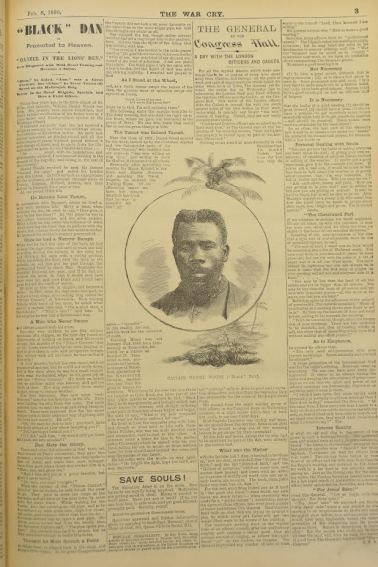
In May 2021 archivist Ruth Macdonald of the Salvation Army’s International Heritage Centre in south London supplied details of two more black Salvationists, from the army’s War Cry. Henry Nicholls (with one L in the War Cry, 3 March 1888 p 5) died in Sheffield in February 1888, aged 22. Born in Baltimore he took a ship to Bristol, and worked in a circus. William Daniel Woods known as ‘Black’ Dan was born in St Kitts, leaving for England in 1879. He worked as a lion tamer and also as a sailor. He died in Hackney, London in the winter of 1889-1890, aged 35. See the War Cry, 8 February 1890 p 3.
In 1892 the widow of Liberia’s first president, Jane Rose Roberts (see page 051), was associated with another US-born Liberian, Martha Ricks who had made a quilt and had come to England to present it to Queen Victoria. In late July, after the two visited Windsor Castle and met the monarch, they attended a Salvation Army meeting in London and met founder-General William Booth (Daily News and Pall Mall Gazette both 26 July 1892.
The history of the Salvation Army in Jamaica names Agnes Foster as one of its two founders, advising that she had been a slave and had lived in England for forty years. Back in Jamaica in the 1880s she pioneered the Army’s development on the island. [see page 156] She had been a member of the Army in Eccles (Manchester) and was an officer based in South Shields in 1883. She returned to Eccles where she died in 1910. One of her three daughters became an officer in England.
Jeffrey Cox’s ‘Going Native: Missionaries in India’ (Wm Roger Louis [editor], Still More Adventures with Britannia (London: Tauris, 2003) page 310 notes ‘an African-American Salvation Army missionary in the Punjab, Zulu John, a lion-tamer by profession. He had been converted by the Salvation Army in the East End of London…and sent out barefoot into the villages to do evangelistic work’. In fact the Philadelphia-born Salvationist was Zulu George, active in England in the early 1880s and detailed in the monthly India’s Cry of January, February and March 1899. I am indebted to Steven Spence of the Salvation Army International Heritage Centre, London SE5 8BQ for copies of that publication and other assistance.
LEAVE ANY RESPONSE IN THE BOX AT THE FOOT OF THE PAGE.
 Jeffrey Green. Historian